A Practical Introduction to Hands-On AI Trading with Python, QuantConnect, and AWS
Artificial intelligence is no longer a peripheral tool in quantitative finance. From machine learning models that uncover subtle market regimes to large language models that interpret unstructured news in real time, AI is increasingly embedded in how modern trading strategies are researched, tested, and deployed.
Yet for many practitioners, the real challenge is not whether to use AI, but how to apply it rigorously, realistically, and at scale.
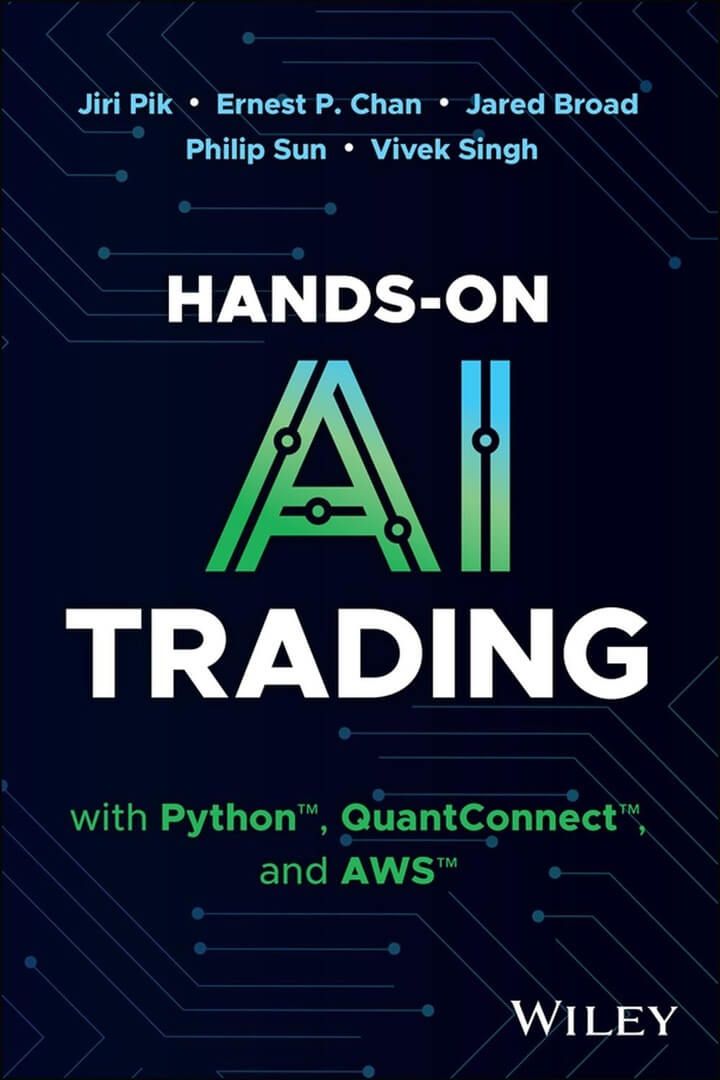
This is precisely the gap addressed by Hands-On AI Trading with Python, QuantConnect, and AWS, a new book published by Wiley. Rather than focusing on abstract theory, the book emphasizes end-to-end, deployable AI trading strategies, built in a professional research environment. In this article, we outline what makes the book distinctive, who it is for, and how it fits into the broader QuantConnect–QuantInsti learning ecosystem.
This blog covers:
- Why This Book Exists
- Author Context: Why the Perspective Matters
- What Makes This Book Different
- Built on QuantConnect: From Research to Deployment
- Free Download: Book Summary (written by Jiri Pik)
- Who Should Read This Book?
- What Readers Are Saying (Early Feedback)
- What You Can Do Next
- Contribute and Collaborate
📌 Key Takeaways
- A hands-on, strategy-first guide to applying AI in real trading workflows
- Over 20 fully coded strategies, spanning ML, deep learning, NLP, and reinforcement learning
- Built entirely on QuantConnect’s institutional-grade research and execution platform
- Emphasis on intuition, interpretation, and decision-making, not just model accuracy
- Designed for practitioners who want working reference implementations, not toy examples
Why This Book Exists
The AI-in-trading landscape has expanded rapidly. Academic papers, blog posts, GitHub repositories, and notebooks are plentiful but fragmented. What is often missing is a coherent, practitioner-oriented path that connects AI ideas to tradable strategies under realistic constraints: data quality, execution frictions, and risk management.
This book was written to bridge that gap.
Rather than treating AI models as black boxes, the authors focus on:
- Why a specific model is appropriate for a given trading problem
- How model outputs should be interpreted by a trader or portfolio manager
- What failure modes look like in live trading, and how to diagnose them
The result is a guide that mirrors how professional quants actually work iterating between hypotheses, models, backtests, and risk evaluation.
Author Context: Why the Perspective Matters
Authority matters in quantitative finance, and this book benefits from a rare combination of perspectives across trading, platforms, and AI infrastructure.
The authors include:
- Jiri Pik – Founder of RocketEdge, with over 20 years of experience building trading and risk systems across banks and hedge funds
- Ernest P. Chan – Quantitative trading expert and founder of PredictNow.ai, widely known for his work on ML-driven trading and risk management
- Jared Broad – Founder and CEO of QuantConnect, whose LEAN engine underpins all strategies in the book
- Philip Sun – Former portfolio manager at WorldQuant and Renaissance Technologies, now CEO of Adaptive Investment Solutions
- Vivek Singh – Senior AI leader at AWS, specializing in large-scale ML and generative AI systems
This blend ensures the material is technically rigorous, operationally realistic, and aligned with modern institutional workflows.
What Makes This Book Different
1. Strategy-First, Not Model-First
Each chapter begins with a trading objective, not an algorithm. Models are introduced only when they add economic or operational value.
Readers learn how to reason about questions such as:
- When does supervised learning outperform rule-based logic?
- How should regime classifiers influence allocation decisions?
- What does overfitting look like after transaction costs?
This philosophy closely mirrors how AI is used in professional quant research.
Read about trading strategies here.
2. 20+ Fully Implemented AI Trading Strategies
At the core of the book are over twenty complete, end-to-end strategies, each including:
- Feature engineering and data preparation
- Model training and validation
- Portfolio construction and risk controls
- Backtest results and performance diagnostics
Representative examples include:
- Crypto trend detection using ML-based trend scanning
- Volatility regime modeling with Hidden Markov Models
- Dynamic asset allocation via neural-network regime classifiers
- Event-driven strategies around stock splits
- Fundamental ML models for dividend yield forecasting
- CNN-based pattern recognition in price time series
- Reinforcement learning for adaptive hedging
- LLM-based news sentiment signals using GPT-style models
Each strategy is written as a deployable QuantConnect algorithm, not a standalone notebook.
Download a detailed book summary.
Built on QuantConnect: From Research to Deployment
All strategies in the book are implemented on QuantConnect’s cloud platform, allowing readers to focus on research rather than infrastructure.
Key benefits include:
- Immediate access to multi-asset historical data
- Institutional-grade backtesting and execution logic
- Seamless transition from research to paper or live trading
This setup reflects real-world constraints such as contract rolls, slippage, margin, and execution costs; making the learning experience directly transferable to professional environments.
For readers new to Quant trading, the free Quantra learning track “Quantitative Trading for Beginners” provides a solid foundation before diving into the book.
Strategy Themes Covered
Volatility & Risk-Aware Strategies
- Volatility forecasting for position sizing
- Regime-aware stop-loss and drawdown control
- ML-driven futures allocation
Regime Detection & Market States
- Momentum vs. mean-reversion classifiers
- PCA-based macro regime modeling
- HMM-based market state inference
Alpha Across Data Types
- Technical signals via deep learning
- Fundamental and event-driven ML models
- Statistical arbitrage enhanced with clustering
NLP, LLMs, and Alternative Data
- Financial news sentiment using FinBERT and GPT models
- Practical considerations for using LLM APIs in trading systems
Readers interested in NLP applications can begin with the free Quantra course “Introduction to Machine Learning in Trading.”
Free Download: Book Summary (written by Jiri Pik)
To help readers quickly evaluate whether this book fits their needs, we’re offering a free downloadable summary based on the full draft version of the book.
📥 Download the free Hands-On AI Trading summary (≈ 5000 words)
(Includes strategy overview, learning outcomes, and practical takeaways)
Who Should Read This Book?
This book is ideal for:
- Quantitative traders and researchers
- Algorithmic trading developers
- ML practitioners entering finance
- Portfolio managers exploring AI-driven signals
- Graduate students preparing for quant or fintech roles
If your goal is to apply AI to real trading decisions, this book is designed for you.
What Readers Are Saying (Early Feedback)
“A rare combination of depth and practicality, these are strategies you can actually build on.”
“Bridges the gap between machine learning theory and real trading systems.”
“Particularly strong on intuition and decision-making, not just code.”
What You Can Do Next
- 📘 Read the book to explore all strategies in depth
- 🎓 Explore free Quantra courses to strengthen specific AI or trading foundations
- 🚀 Apply the strategies on QuantConnect, adapting them to your own research
Contribute and Collaborate
At QuantInsti, we believe the future of algorithmic trading depends on shared learning and open collaboration. Our mission is to make advanced tools and research in quantitative finance accessible to all, helping both individuals and institutions navigate complex markets with confidence.
If the ideas explored in this blog speak to you, we invite you to contribute to the global community of quants. Whether you are building strategies, developing tools, conducting research, or applying AI in new ways, your work can add real value. To get started, read our Blog Contribution Guidelines. Every contribution helps grow the shared knowledge base and supports the evolution of quantitative trading. Let’s build the future together.
Disclaimer: This blog post is for informational and educational purposes only. It does not constitute financial advice or a recommendation to trade any specific assets or employ any specific strategy. All trading and investment activities involve significant risk. Always conduct your own thorough research, evaluate your personal risk tolerance, and consider seeking advice from a qualified financial professional before making any investment decisions.